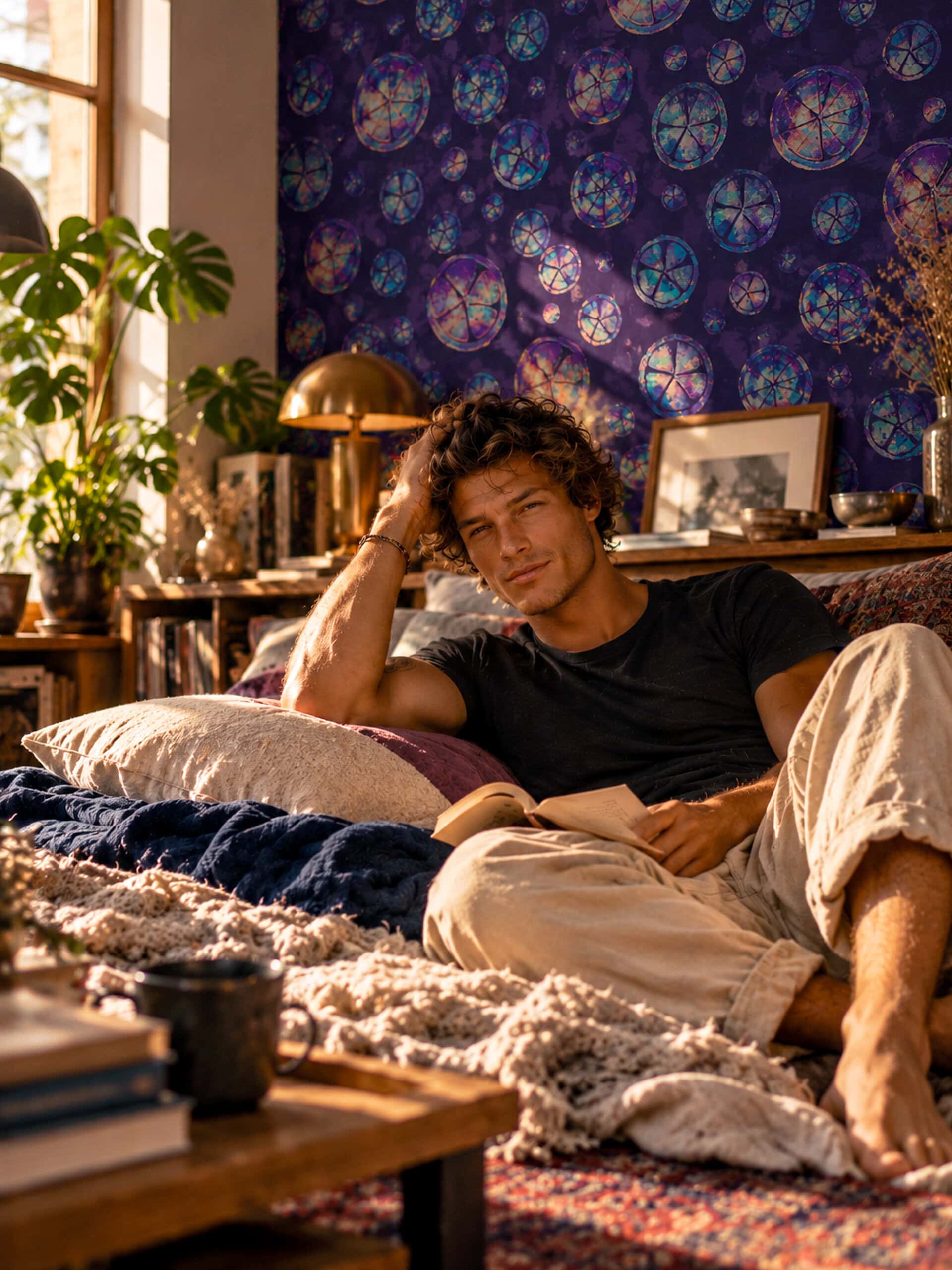


Dark Purple Wallpaper
Cosmic_Noir Collection · Cosmic_Noir_Midnight Orange
63 EUR per sq m
Roll size: 53 cm × 10 m (5.3 m²)
This dark purple wallpaper began as a hand-carved linocut. A halved orange was drawn from life, cut into a linoleum block and printed by hand, and the resulting citrus discs, with every gouge mark and uneven pass of ink intact, were then set on a deep midnight-purple ground in violet, teal and turquoise. The questions below explore the ideas behind it: the colour, the printmaking technique and the maximalist interiors it was designed for.
What is dark purple wallpaper, and how does it change the atmosphere of a room?
Dark purple wallpaper is a wallcovering with a predominantly deep violet, aubergine, plum or midnight-purple background. Depending on its undertones, it can appear almost black in subdued light or reveal a surprisingly complex range of blue, red and violet as daylight moves across the room. What makes dark purple particularly interesting in interior design is its relationship with light and neighbouring colours. Against a deep violet background, turquoise, coral, ochre and metallic accents acquire an intensity that would be difficult to achieve on white. The dark ground allows lighter motifs to become more prominent, while it visually recedes between them.
Purple also carries a remarkable cultural history. As the Carnegie Museum of Natural History explains, Tyrian purple, a dye made from murex shellfish and produced in the Phoenician city of Tyre, was so costly that only the wealthiest could afford it, and the Romans adopted purple as a symbol of imperial authority and status. Although contemporary purple pigments bear little resemblance to those historical materials, the colour has retained associations with theatricality, richness and the unconventional. In contemporary interiors, dark purple offers an alternative to the more familiar charcoal, navy and forest-green palettes. It can bring unexpected warmth to a modern room, particularly when paired with aged timber, lacquered furniture, sculptural lighting or contemporary art.
A dark wallpaper does not automatically make a room feel smaller. Used across several walls, it can soften architectural boundaries and create an intimate, enveloping atmosphere. On a single wall, it establishes a strong visual anchor, particularly when the surrounding furniture and artwork are carefully composed.
What is a linocut, and why did modern artists embrace this printmaking technique?
A linocut is a relief-printing technique in which an artist carves an image into a sheet of linoleum, inks the remaining raised surface and transfers the design onto paper or fabric. The carved areas remain unprinted, producing the bold contrasts, expressive contours and distinctive marks associated with the medium. According to Tate, the lino block is a thin layer of linoleum, a canvas backing coated with solidified linseed oil, usually mounted on wood. Because linoleum is soft and has no grain, it can be cut more easily than a woodblock and in any direction, allowing curves, diagonals and intricate shapes to be carved with considerable freedom, while its slightly textured surface accepts ink evenly. Originally developed as a floor covering in the nineteenth century, linoleum became popular with artists and amateurs for printmaking in the twentieth. The technique proved remarkably versatile. Between the wars, artists associated with London’s Grosvenor School of Modern Art, among them Sybil Andrews, Claude Flight and Cyril Power, used colour linocut to convey the vitality of everyday life in the machine age, as a Metropolitan Museum of Art publication on British modernist prints describes. The Museum of Modern Art’s collection shows how wide the range of approaches became, from Sybil Andrews’s Speedway (1934) to Pablo Picasso’s Still Life with Glass Under the Lamp (1962) and Elizabeth Catlett’s Malcolm X Speaks for Us (1969). One of the most compelling qualities of linocut is that the process remains visible in the finished image. The pressure of the carving tool, the irregular edge of a cut and the occasional variation in ink coverage become part of the artwork’s character. These characteristics are especially interesting when translated into contemporary surface design. Enlarging or repeating a linocut image can reveal details that might otherwise go unnoticed in a small print. A carved line becomes a graphic gesture; a tiny irregularity becomes an expressive feature. The result retains something of the original encounter between the artist’s hand, the material and the printing surface.
What is maximalism in interior design, and how is it different from eclecticism?
Maximalism is an approach to interior design that embraces expressive colour, layered patterns, contrasting materials and visually rich compositions. Rather than seeking harmony through reduction, it allows multiple decorative elements to coexist, often drawing inspiration from different artistic movements, historical periods and cultural traditions. Although maximalism is frequently described as the opposite of minimalism, the distinction is more interesting than simply having more objects in a room. A successful maximalist interior is not an accumulation of unrelated possessions. It is a carefully constructed composition in which colour, scale, rhythm and contrast establish relationships between apparently disparate elements. The intellectual background of this approach has important connections with postmodern architecture and design. In 1966 the Museum of Modern Art published Robert Venturi’s Complexity and Contradiction in Architecture, now widely regarded as a foundational text of postmodernism and a rebellion against the purism of modernism. Venturi’s celebrated response to the modernist principle of less is more, less is a bore, captured a growing interest in complexity, historical reference, symbolism and contradiction. Eclecticism and maximalism are related, but they are not interchangeable. Eclectic interiors combine furnishings, objects and influences from different periods or styles. Maximalism describes the intensity and richness of the overall composition. An eclectic room may be remarkably restrained, while a maximalist interior can be created almost entirely with contemporary furniture and materials. In practice, the most convincing maximalist rooms often rely on a strong underlying structure. Repeated colours connect contrasting patterns. Furniture with simple silhouettes balances elaborate textiles. Empty areas give the eye somewhere to rest, allowing decorative elements to retain their impact. A richly patterned wallpaper can provide the starting point for such a scheme, establishing a palette and visual rhythm that informs the rest of the room. Equally, it can introduce a deliberately disruptive element into an otherwise understated interior. Maximalism, at its best, is not about filling every available surface. It is about understanding how much visual complexity a room can carry, and making that complexity worthwhile.
How do you decorate a room with dark purple wallpaper?
Decorating with dark purple wallpaper begins with understanding its undertones and how they interact with natural and artificial light. Blue-based violets tend to create a cooler, more dramatic atmosphere, while red-based plum and aubergine shades introduce greater warmth and often work particularly well with timber, leather and aged metallic finishes. For a sophisticated contemporary scheme, dark purple can be combined with petrol blue, deep teal, burnt orange or muted coral. These combinations create a richer and less predictable palette than the conventional pairing of purple and gold. Material contrast is equally important. Lacquered surfaces, polished timber, smoked glass and brushed metal reflect light differently, introducing depth and preventing a dark interior from appearing visually flat. Velvet, wool, linen and leather add another dimension through texture. Furniture does not necessarily need to be dark. A pale upholstered chair, a white lacquered console or a sculptural piece in natural wood can create a compelling contrast against a saturated purple wall. Vintage pieces are particularly effective when their patina and proportions provide a counterpoint to the graphic character of the wallpaper. Lighting deserves careful consideration. Deep colours can change significantly between daylight and evening illumination. Wall lights, shaded table lamps and directional lighting can reveal different aspects of a patterned surface, while warm pools of light create a more intimate atmosphere than uniform overhead illumination. Dark purple wallpaper is particularly effective in bedrooms, dining rooms, libraries and entrance halls. It also has considerable potential in hospitality interiors, where restaurants, cocktail bars and boutique hotels can use saturated colour to establish a distinctive atmosphere. For a more restrained interpretation, allow the wallpaper to carry most of the colour and keep the furniture relatively simple. For a bolder scheme, introduce contrasting artwork, patterned upholstery or a vintage rug that shares one or two colours with the wall. The essential consideration is balance, not restraint. A dark purple interior can accommodate extraordinary colour and decorative variety, provided the relationships between its elements are intentional.

Not sure yet? Touch it first.
Pick 3 samples.
Get 2 more on us.
Keep them, or pass them to a friend who's still living with beige. Spread the vibe — it always comes back around.
Made to order — production takes 5-7 working days, then shipped to your door.
Not sure this is right for your room? Write us an email or book a free 1-hour design consultation →
The Story
Styling This Wallpaper
Bought it.
Loved it.
Brag about it
We're a small studio, not a brand with a review army. Every word you leave here matters a lot to us, and it helps the next person find their wall.
— Barbara & the studioQuestions About This Pattern
Do I need an interior designer to choose the right wallpaper?
Not necessarily. Most people can choose confidently on their own — and if you'd like a second opinion, email us or book a free 1-hour design consultation with the studio for guidance on colour, pattern and placement. A paid consultation is only needed if you're after a full interior design service for your space, beyond just choosing a pattern.
Can I order a sample of this wallpaper first?
Yes — ordering a sample is optional but recommended. Screen colours can differ slightly from the printed result, so a sample confirms the exact tone in your own light before you commit to the full wall.
Can I customise the size or colour?
Size is always made to your exact wall dimensions — just enter height and width. Colour customisation is available for most designs; this piece is part of our standard collection, not a limited-edition print, so recolouring is possible on request.
How long does production take?
5-7 working days. Every Vesper Royale wallpaper is made to order — we hold no stock — so production begins only once you place your order.


Reviews
There are no reviews yet.